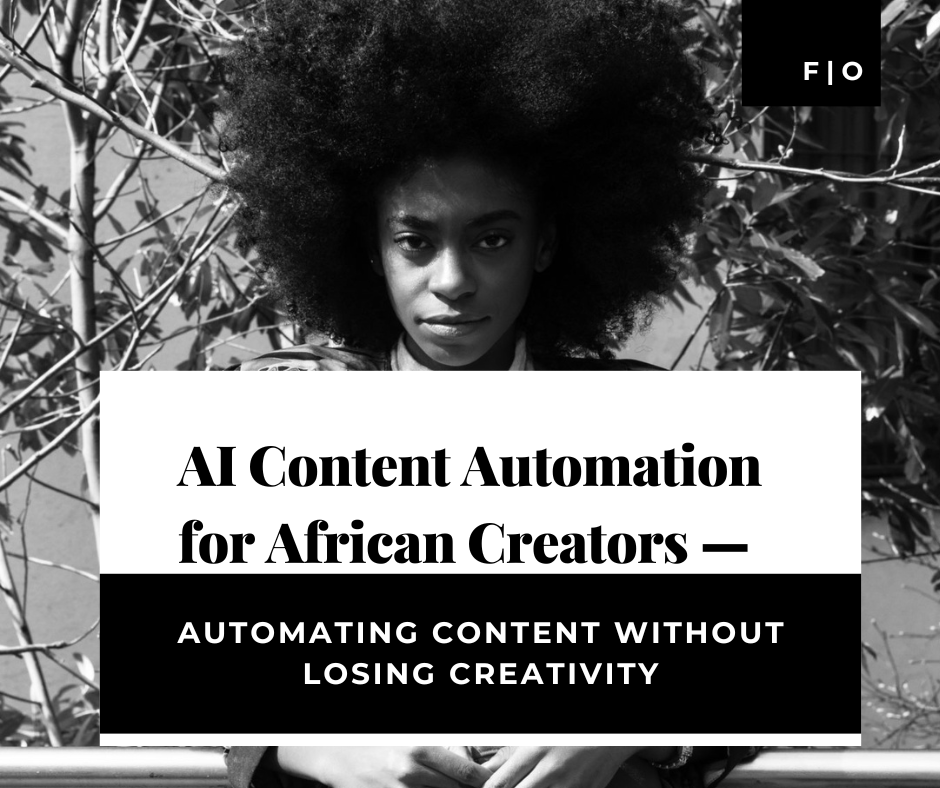
AI is not replacing creators. It replaces repetition. Across Africa, content demand is rising faster than teams, budgets, and production capacity. Creators are expected to post daily, repurpose content for multiple platforms, maintain brand voice, engage communities, and track performance — all with limited time and tools.
That’s where AI can help. But AI is not magic. It works only when there is a clear workflow, a defined goal, and real human experience behind the content. Used correctly, AI becomes a capacity extender — helping African creators research faster, draft ideas quicker, repurpose content across platforms, and schedule distribution intelligently.
If you’re exploring how AI and automation are reshaping African digital businesses as a whole — including regulation, infrastructure, and market trends — start with our main guide on AI & Automation for African Digital Businesses.
AI doesn’t make creators irrelevant.
It makes consistent creativity finally possible — even with small teams and limited hours.
Why African Creators Need AI
African creators are producing more content than ever before — but most are doing it with the same number of hours, the same tools, and often no additional support. The pressure to stay visible online grows faster than their capacity to create. AI becomes valuable not because it replaces creativity, but because it rescues time and reduces workload when used correctly.
African creators don’t need AI for ideas — they need AI for repetition.
Rising Content Demand With No Increase in Staffing
Creators are now expected to:
- post daily
- repurpose content across platforms
- respond to comments and messages
- manage brand voice and visuals
- report performance to clients or brands
But most creators are one-person teams or work with one assistant who handles everything. Without AI, the only way to grow is to work more hours, which leads to burnout, irregular posting, and inconsistency.
AI helps extend capacity without increasing hiring.
One person can now operate like a small team — if workflows are clear.
Mobile-First Behavior — AI Must Fit Phones, Not Desktops
Most African creators work on their phones, not laptops. Tools must therefore:
- be mobile-first
- load quickly, even on low bandwidth
- support WhatsApp, Instagram, Facebook, YouTube Shorts and TikTok
- allow voice notes, image inputs and quick edits
AI must fit how creators already work — not force them to change behavior. If a tool requires constant desktop access or strong internet, it may fail in real conditions.
African Constraints: Bandwidth, Data Cost & Trust Issues
Creators aren’t just managing their workflow — they’re managing African digital conditions:
| Constraint | Impact on Content |
|---|---|
| Bandwidth drops | Uploads fail, tools freeze |
| High data cost | Limits large file exports or cloud tools |
| Power issues | Kills momentum during editing/posting |
| Trust concerns | Audiences fear automated replies |
That means AI must be lightweight, mobile-ready, and human-led. If content feels robotic, trust fades — especially in commerce, health, education, and financial niches.
Why Creators Burn Out Before Growing
Most creators burn out not because of lack of talent — but because of routine tasks:
- writing new captions every day
- replying to the same question 50 times
- editing small mistakes manually
- struggling to adapt one idea for multiple platforms
This leads to content fatigue, inconsistency, and loss of momentum — especially when life gets busy.
That’s why African creators turn to AI:
Not to replace creativity — but to protect it.
What AI Can Do in Content Workflows
AI isn’t here to replace creators — it’s here to remove repetition from the workflow. Content creation becomes easier when we stop asking AI to think for us and instead ask it to handle the tasks that slow us down.
When creators understand where AI fits into their process, they gain speed without losing their voice or originality.
Here’s how AI can support each stage of a content workflow:
| Stage | AI Use Case | Human Role |
|---|---|---|
| Ideation | Topic expansion & variations | Decide relevance and direction |
| Research | Scan trends, summarize sources | Verify facts and credibility |
| Drafting | Generate outlines & first drafts | Refine tone and accuracy |
| Repurposing | Convert one idea into multiple formats | Adapt for culture and platform |
| Distribution | Schedule and track posts | Reply, engage, and build trust |
AI can help produce content faster.
But only humans can make content worth sharing.
Before using AI tools, creators should define their workflow first.
You can use our step-by-step guide on How to Build an AI & Automation Strategy for African Startups to map the right process before applying automation.
AI builds capacity.
Structure + emotion + context still come from the creator.
Tools Built for African Conditions: What Actually Works
AI only becomes useful when it fits real-life African conditions:
mobile-first workflow, unstable internet, cost limits, chat-first customers, and cultural nuance
That’s why the best tools aren’t always the newest ones; they’re the most adaptable to how creators in Africa already work. Below are the tools that have proven to work in real African creator workflows.
WhatsApp Automation: The Real “Backend” of African Content
Most conversations, leads, and distribution happen on WhatsApp—so it makes sense to automate parts of it:
- Quick replies for FAQs
- Lead tagging & categorization
- Broadcast reminders for new uploads/content
- Escalation to human support after bot response
AI doesn’t replace WhatsApp.
It makes WhatsApp easier to manage at scale.
Canva Bulk Design—1 Template, 20 Posts
Creatives often lose hours designing individual graphics. Canva’s Bulk Create feature allows one spreadsheet to generate multiple visuals instantly:
- Quote threads
- Carousels
- Promo graphics
- Story templates
This keeps visual identity consistent without hiring a designer.
Airtable / Notion—Content Workflow Mapping
These apps help creators track:
- content ideas
- publishing schedules
- repurposing formats
- brand voice guidelines
- community comments & insights
They form the “memory system” of the creator, something AI alone cannot replace.
ChatGPT: Drafts, Scripts & Starting Points
ChatGPT is not the writer.
It is the first draft assistant. Creators use it for:
- post outlines
- captions and CTAs
- newsletter rough drafts
- video scripts (“explain like I’m 12” method)
- turning voice notes into written scripts
Creators still refine tone — AI helps remove starting pressure.
Meta Business Suite — Smart Reach on Auto-Pilot
Meta Business Suite (free) schedules:
- Instagram posts
- Facebook posts
- Stories
- Ad drafts
It helps creators plan 30 days of content in a single session — without constant manual uploads.
AI for Local Languages & Tone
AI tools are beginning to support African languages and regional dialects. Creators use AI to test messaging tone for:
- Nigerian English vs Kenyan English
- Urban vs rural phrasing
- Formal vs conversational style
- Clone voice notes into scripts
This helps creators match culture without losing clarity.
If you want tool recommendations by category, cost, and training level, see our full list in;
Top 10 Automation Tools for SMEs in Africa (and How to Pick One)
Building the “Content Engine” Concept
Most creators produce content one post at a time. But African creators who scale are not just “posting”—they are building systems.
When creators build a content engine, they stop starting from zero every week. One idea can become 10+ pieces of content, distributed across platforms—with AI doing part of the work.
Here’s the simple flow of a content engine:
Flow:
Idea → Draft → Repurpose → Distribute → Track → Improve
Let’s break it down using entities and real workflow structure.
Idea — Start with a Core Thought
- Pain point
- Question from audience
- Trend/news update
- Lesson or personal story
AI helps expand the idea—but humans choose the angle and purpose.
Draft — Let AI Remove the Blank Page
- Script outline
- Caption starter
- Hook variations
- Newsletter draft
AI gives direction, but tone and voice still need human editing.
Repurpose—Turn One Idea into Multiple Formats
| Format | Example |
|---|---|
| Tweet thread | Break down the insight step-by-step |
| Instagram carousel | Visual summary of the core concept |
| TikTok/Reel script | Voice note → AI → video idea |
| Newsletter | Expanded version with story |
| LinkedIn post | Professional slant on same topic |
AI can convert formats. Only humans give context & local nuance.
Distribute — AI Helps, But Humans Build Trust
Tools like Meta Business Suite, WhatsApp Broadcast, Airtable, or Buffer help push content out efficiently.
But real replies still need a human, especially in African markets where trust is low and personalization matters.
Track—See What Works Before Posting More
AI or sheets can help track:
- Views
- Saves
- Replies & comments
- DM questions
- Shares
These patterns show what to post next, making your workflow smarter—not just faster.
Improve—This Is Where Growth Happens
AI improves when we improve. After observing performance:
- refine the idea
- improve headlines
- adjust tone/language
- target a new audience segment
Optimization turns content into a system.
Key Entities for the Content Engine
| Entity | Role in System |
|---|---|
| Airtable / Sheets | Content tracking & repurposing plan |
| AI tools | Remove repetition (not thinking) |
| Analytics | Learn what works & why |
The goal isn’t to post more.
The goal is to create once—and scale the message across platforms, using AI as an assistant—not a replacement.
When AI Should NOT Be Used
AI is powerful—but only when the foundations are solid. Knowing when not to use AI helps creators protect trust, maintain quality, and avoid generic content that loses authority.
Below are situations when AI should take a supporting role—or be avoided entirely.
No Established Voice
If your brand tone isn’t defined yet, AI will produce generic content.
AI learns from your voice — it cannot invent it for you.
Without a clear style, all your posts will sound like everyone else’s.
Human first: define tone, vocabulary, rhythm, examples.
AI later: assist with structure—not personality.
No Defined Workflow
AI can speed up a process—but it cannot create one.
If your workflow is different every week, AI automation will fail.
First, structure your content flow:
Idea → Draft → Edit → Repurpose → Publish → Track
Only after this is clear should AI enter the process.
No Real Experience or Proof
AI cannot fake lived experience.
Content without proof, stories, or real data damages credibility — especially in niches like health, finance, education, business coaching, and legal advice.
Creators must input real knowledge. AI can help organize it.
But authenticity cannot be automated.
Sensitive Cultural Messaging
AI still struggles with:
- regional slang
- ethnic/cultural nuance
- local humour
- political or historical context
If tone is misinterpreted, audiences may feel misunderstood—or even offended.
In these cases, AI can suggest, but creators must approve every word.
Data Integrity Issues
AI depends on clean input. If your:
- content files
- leads
- notes
- customer messages
…are scattered across WhatsApp chats, voice notes, screenshots, PDFs, and spreadsheets, AI outputs will be chaotic.
Organize the data first. Automate later.
AI Should Not Replace Insight — Only Process
AI works best when creators:
-know their voice
-understand their audience
-organize their data
-have clear workflow steps
That’s when AI extends creativity — without damaging trust.
Conclusion — AI Extends Reach, Not Replaces Creators
AI is not here to take the place of creators. It is here to expand what one creator can do, especially in Africa—where time, tools, and resources are limited. The creators who grow are not the ones who post the most. They are the ones who build systems, protect their energy, and use AI to remove friction from their work.
Workflow first. Tools second. Insight always.
That is how African creators scale without losing identity, originality, or connection to their audience.
In low-resource environments, AI becomes a force multiplier—not a replacement for creativity. The creator still leads. AI simply helps carry the weight.
Because the future doesn’t belong to creators who work harder.
It belongs to creators who work with smart systems.